
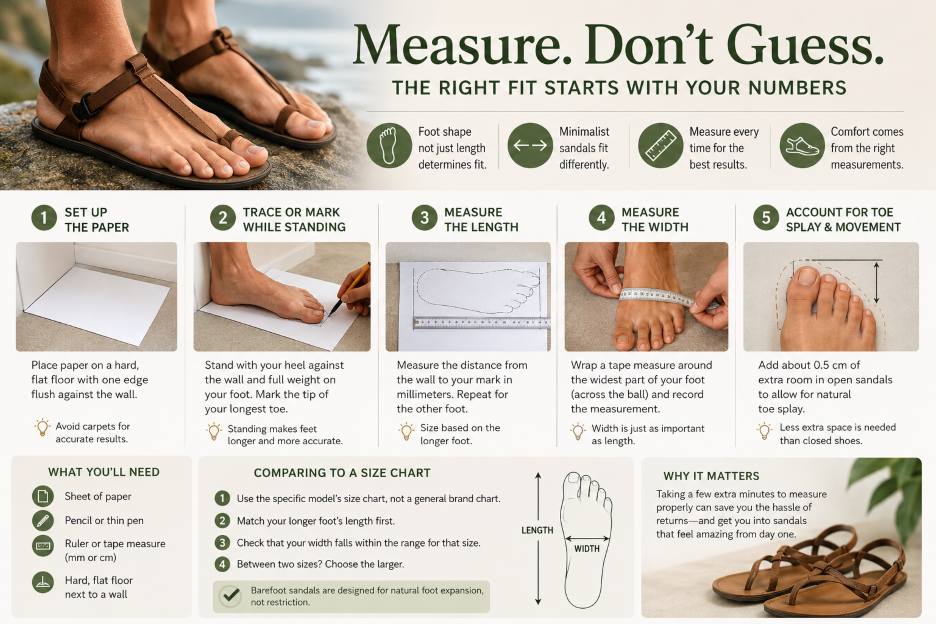
Foot length alone does not always tell you whether minimalist footwear will fit well. Research published in the Journal of Sports Sciences by Devon Coetzee and colleagues describes minimalist shoes as having thin, flexible soles with little or no difference in height between the heel and toe.
These features allow the foot to sit and move differently than it does in a padded shoe. This is one reason first-time buyers may struggle to find the right size.
Sandals can make sizing even more important. They do not have a closed upper to hold the foot in place. Because of this, sizing barefoot sandals (סנדלי ברפוט) depends heavily on accurate foot measurements.
Your usual shoe size may not be a good guide. For example, someone who wears a size 9 running shoe may need a different size in barefoot sandals. The thin sole and straps change how the sandal fits and supports the foot.
Why Regular Shoe Sizes Don’t Always Work
Regular shoes often become narrower near the toes. This shape can push the smaller toes inward. Barefoot footwear uses a different shape that gives the toes more room.
Guidance from Bespoky Shoes notes that barefoot shoes should be widest around the toes. This follows the foot’s natural shape instead of pushing the toes into a narrow space. Because of this difference, your usual shoe size may not match your barefoot sandal size.
Sole thickness and strap placement can also differ between brands. Two barefoot sandals marked as the same size may still fit differently.
For this reason, footwear resources such as Anya’s Reviews recommend measuring your feet before buying a new pair. Do not depend only on the size of sandals or shoes you bought in the past.
What You’ll Need to Measure Your Feet
Before you start, gather these simple items:
- A sheet of paper large enough for your foot
- A pencil or thin pen
- A ruler or tape measure with millimeters or centimeters
- A hard, flat floor next to a wall
Step 1: Set Up the Paper
Put the paper on a hard, flat floor. Place one edge directly against the wall.
Freet Barefoot’s fitting guide recommends avoiding carpet when measuring. A soft surface may affect the shape of your foot or the position of the paper. Even a small change can affect your final measurement.
Step 2: Mark Your Foot While Standing
Stand on the paper with your heel touching the wall. Put your full weight on the foot you are measuring.
Standing is important because your foot spreads slightly when it carries your body weight. Barefoot Shoe Guide notes that a foot measured while sitting may appear shorter than it does while standing.
Keep your pencil straight up and down. Mark the end of your longest toe. Remember that your longest toe may not always be your big toe.
Step 3: Measure the Length
Step away from the paper. Use a ruler to measure from the edge that touched the wall to the mark for your longest toe.
Record the measurement in millimeters if possible. Millimeters give you a more exact number and reduce the need for rounding.
Repeat the process with your other foot. It is common for one foot to be slightly longer than the other.
When choosing a sandal size, use the measurement of your longer foot. This helps make sure both feet have enough room.
Step 4: Measure the Width
Length is only part of finding the right fit. You should also measure the width of your foot.
Use a soft tape measure around the widest part of your foot. This is usually across the ball of the foot, near the base of your toes. Write down the measurement.
Width matters with barefoot sandals because the straps need to sit in the right place. Sandals that are too narrow may push your foot over the edge of the sole. A sandal that is too wide may allow too much movement while walking.
Step 5: Leave Room for Your Toes to Move
Barefoot sandals are designed to give your toes space to spread as you walk. Your foot should not reach the very edge of the sandal.
Guidance from Shuu Barefoot suggests leaving about half a centimeter of extra space in open sandals. Closed barefoot shoes often need more room because they have a toe box and may be worn with socks.
The extra space should be small. Too much room can make the sandals harder to walk in, while too little can limit natural foot movement.
Comparing Your Measurements to a Size Chart
Once you have your length and width measurements, check the size chart for the exact sandal model you want to buy. Avoid using only a brand’s general size chart.
Different styles from the same company can have slightly different sole lengths and widths. Start by matching the measurement of your longer foot. Then check whether your foot width fits the listed range.
Before choosing a size:
- Use the measurement of your longer foot.
- Check both length and width.
- Look at the size chart for the exact sandal model.
- Allow a small amount of space for natural toe movement.
- If you fall between sizes, check the brand’s fitting advice before ordering.
Taking a few extra minutes to measure your feet can help you avoid an uncomfortable fit or a return. It also gives your toes enough space to move naturally.
Once you have the right fit, you can think about how to wear your sandals with different clothes. This roundup of summer outfits for men offers ideas for pairing minimalist sandals with simple warm-weather outfits.