
Foot length alone rarely predicts a good fit in minimalist footwear. Research published in the Journal of Sports Sciences by Devon Coetzee and colleagues describes minimalist designs as those with thin, flexible soles and little to no drop between heel and toe, which means the foot sits and moves very differently inside them than it does in a cushioned, structured shoe. That difference is exactly why so many first-time buyers end up disappointed with their order.
Sandals make this even more noticeable. Because there is no enclosed upper holding the foot in place, sizing barefoot sandals (סנדלי ברפוט ) depends almost entirely on precise measurements rather than a familiar shoe size carried over from sneakers or boots. A person who normally wears a size 9 in running shoes may need a completely different number once the sole is thin and the straps are doing the work a padded upper used to do.
Why Regular Shoe Sizes Don’t Translate
Conventional shoes are built around a tapered last that narrows toward the toes, often squeezing the smaller toes inward. Minimalist footwear takes the opposite approach. Guidance from Bespoky Shoes notes that a proper barefoot fit is widest at the toes, mirroring the natural shape of a healthy foot rather than forcing it into a point. That structural difference means the numeric size on a familiar shoebox has little bearing on what a barefoot sandal will feel like on the same foot.
Sole thickness and strap design vary from brand to brand too, so even two pairs of barefoot sandals from different makers can fit differently at the same labeled size. Because of this, footwear educators such as Anya’s Reviews, a resource focused on minimalist footwear, recommend measuring fresh before every purchase rather than relying on memory of a past size.
What You’ll Need to Measure Your Feet
- A sheet of paper large enough for your whole foot
- A pencil or thin pen
- A ruler or tape measure marked in millimeters or centimeters
- A hard, flat floor next to a wall
Step 1: Set Up the Paper
Place the paper on the floor with one edge flush against the wall. Findings from Freet Barefoot’s fitting guide suggest doing this on a hard surface rather than carpet, since a soft surface can distort the outline slightly and throw off the final number.
Step 2: Trace or Mark Your Foot While Standing
Stand on the paper with your heel touching the wall and your full weight resting on that foot. This detail matters more than it seems. Data from Barefoot Shoe Guide indicates that a foot measured while seated can read noticeably shorter than the same foot measured while standing, because body weight naturally spreads the foot outward. Keep the pencil perpendicular to the paper and mark the tip of your longest toe, which is not always the big toe.
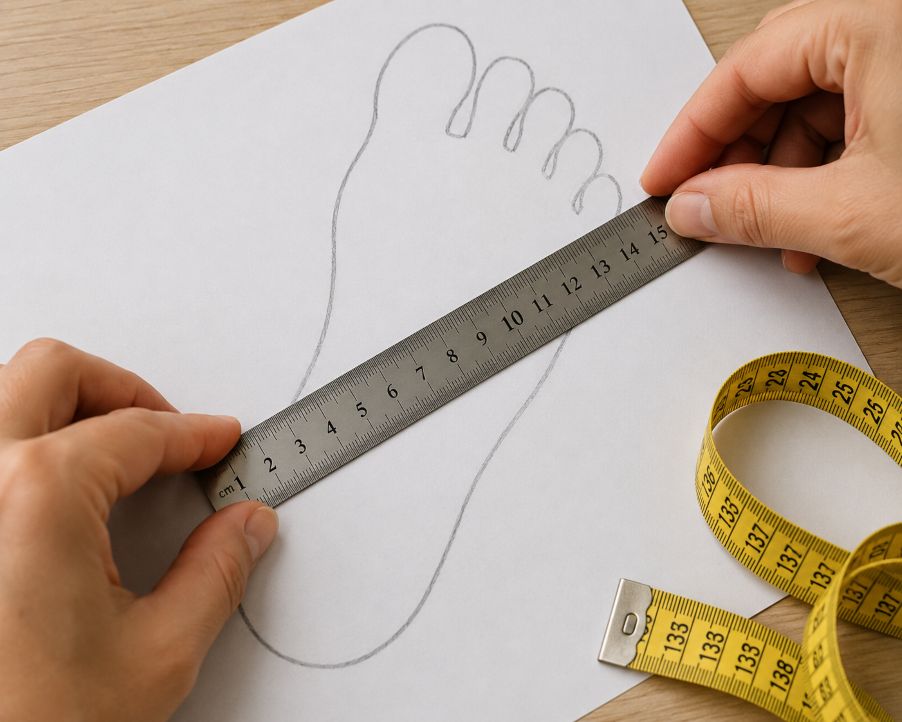
Step 3: Measure the Length
Step off the paper and use your ruler to measure the straight-line distance from the wall edge to your pencil mark. Record this number in millimeters if you can, since it removes the guesswork that comes with rounding fractions of an inch. Repeat the entire process for the other foot. Most people have a small difference between their two feet, and the general recommendation, echoed across multiple barefoot footwear guides, is to size based on the longer measurement.
Step 4: Measure the Width
Wrap a soft tape measure around the widest part of your foot, typically across the ball of the foot at the base of the toes, and note that figure as well. Width is often the detail people skip, yet it is just as important in open sandals as in closed shoes, since a strap sitting too far in or out changes how the sandal sits during walking.
Step 5: Account for Toe Splay and Movement
Barefoot sandals are meant to let the toes spread naturally with each step, so a small margin beyond your raw measurement is expected. Guidance from Shuu Barefoot suggests leaving roughly half a centimeter of room in open sandals, less than what closed barefoot shoes typically call for, since the toes are already exposed to open air and don’t need extra clearance for socks or a toe box wall.
Comparing Your Numbers to a Size Chart
Once both measurements are recorded, set them next to the specific size chart for the sandal model you’re considering rather than a brand’s general sizing page. Insole lengths can shift slightly between styles even within the same company. Match your longer foot’s length first, then check that the width falls within the range listed for that size. If your measurements sit between two listed sizes, most fitting guides recommend choosing the larger option, since barefoot sandals are designed to accommodate natural foot expansion rather than restrict it. Taking a few extra minutes with a ruler now can save the hassle of a return later, and it puts the odds of a comfortable, well-fitted pair firmly in your favor. Once the fit is settled, the next question is usually how to style them, and a good place to start is this roundup of summer outfits for men, which offers plenty of ideas for pairing minimalist sandals with warm-weather looks.